
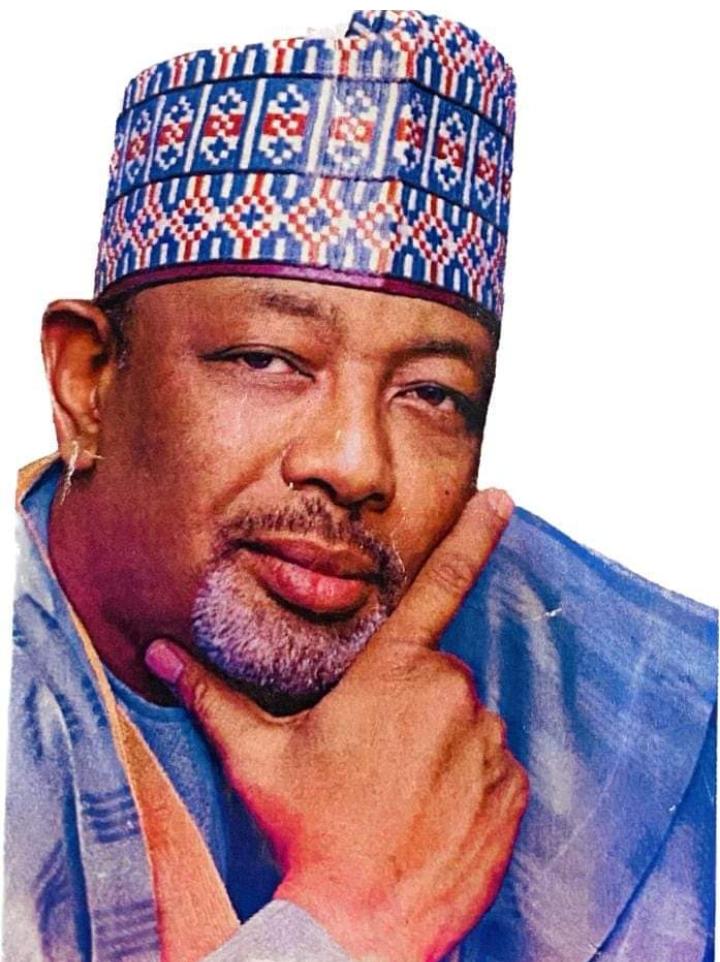
Abubakar Kyari: The Quiet Strategist Poised To Steer Borno Into A New Era
By Abdulkarim Ibrahim
As the race toward 2027 quietly gathers steam, one figure continues to command unusual consensus within the All Progressives Congress (APC) in Borno State – Abubakar Abba Kyari. In a political climate where noise often drowns substance, Kyari stands out as the calm, calculating force with the résumé, relationships and resolve to lead a state still navigating the long shadows of insecurity. His aspiration is not just gaining traction, it is increasingly being framed as inevitable.
Born in 1963 into the respected household of Brigadier Abba Kyari, the senator’s story is rooted in discipline, service and responsibility. As the eldest of nine children from Mobbar Local Government Area, Kyari grew up with an instinct for leadership and a deep sense of duty.
Those who know him often speak first not of his titles, but of his temperament – approachable, composed and quietly generous, with a personal commitment to the vulnerable that has become a defining feature of his public life.
His intellectual foundation reflects both local grounding and global exposure. From Kaduna Capital School to the elite Barewa College, Zaria, and onward to the United States, where he earned a Bachelor’s degree from the University of Tennessee Martin and an MBA from Webster University, Missouri, Kyari built a worldview that blends international best practices with grassroots realities.
That dual perspective would later shape his methodical approach to governance and development.
Kyari’s transition from the private sector into politics in 1998 marked the beginning of a career defined by courage and consistency. From his early victories in the House of Representatives under the defunct UNCP and APP, to his bold legislative interventions, he quickly established himself as a voice for justice and development. Notably, as Chairman of the House Committee on the Downstream Sector, he championed renewed oil exploration in the Chad Basin – an initiative that signaled his foresight in economic diversification for the region.
But it was in executive responsibility that his impact became most tangible. As Commissioner for Works, Housing and Urban Development in 2003, Kyari confronted a state grappling with collapsed infrastructure. Rather than scatter efforts, he zeroed in on water, arguably the most urgent need. The results were immediate and measurable. He restored urban water systems and sunk over 160 boreholes across rural communities. Years later, as Chief of Staff, he led a high-pressure initiative to deliver 100 boreholes in 100 days, achieving nearly full execution, an example of efficiency that still circulates in governance circles.
As elected Senator for Northern Borno senatorial district in 2015, Kyari evolved into a national figure with strategic influence. His stewardship of critical Senate committees – Defense, INEC, and Power among others placed him at the intersection of security, electoral integrity and infrastructure oversight.
These roles were not ceremonial; they provided him with first-hand exposure to the architecture of Nigeria’s security framework, a credential that now weighs heavily in discussions about Borno’s future.
That security question remains central. For a state that has endured years of insurgency and instability, the next governor must be more than a political figure, he must be a security strategist. Kyari’s experience in defense oversight, combined with his deep local knowledge and federal connections, positions him uniquely to bridge policy and action.
He understands the terrain, the stakeholders and the urgency. More importantly, he has demonstrated the ability to coordinate complex responses – an essential trait in confronting persistent security challenges.
As Minister of Agriculture and Food Security under the administration of Bola Ahmed Tinubu, Kyari is once again proving his mettle. His policies have not only boosted food production but also re-engaged thousands of youths and women in farming—reviving livelihoods and strengthening food security nationwide. His role as Chairperson of the Governing Council of the International Fund for Agricultural Development (IFAD) further underscores his global relevance and administrative competence.
Within the APC, the calculus is becoming clearer: electability, experience and effectiveness. Kyari checks all three boxes and many more. He is seen as a unifier in a party that must avoid fragmentation, a technocrat in a system that demands results and a grassroots politician with elite competence. In short, he is both familiar and formidable.
As 2027 approaches, Borno faces a defining choice. Continue with uncertainty, or consolidate progress under a leader who understands both the scars of the past and the blueprint for the future. In Abubakar Kyari, many see not just a candidate, but a solution – steady, seasoned and ready.
Abdulkarim Ibrahim is an analyst wrote from Kano.