
Federal Character Committee Submits Report to Kano Government, SSG Vows To Secure State’s Full Entitlements
The Technical Committee on Federal Character Application and Compliance has submitted its comprehensive report to the Kano State Government, with the Secretary to the State Government (SSG), Alhaji Umar Faruk Ibrahim, assuring that the administration will vigorously pursue and fully utilise all opportunities and entitlements legitimately due to the state under the Federal Character principle.
This was contained in a press statement issued to newsmen by the Press Secretary to the Office of the Secretary to the State Government, Musa Tanko Muhammad.
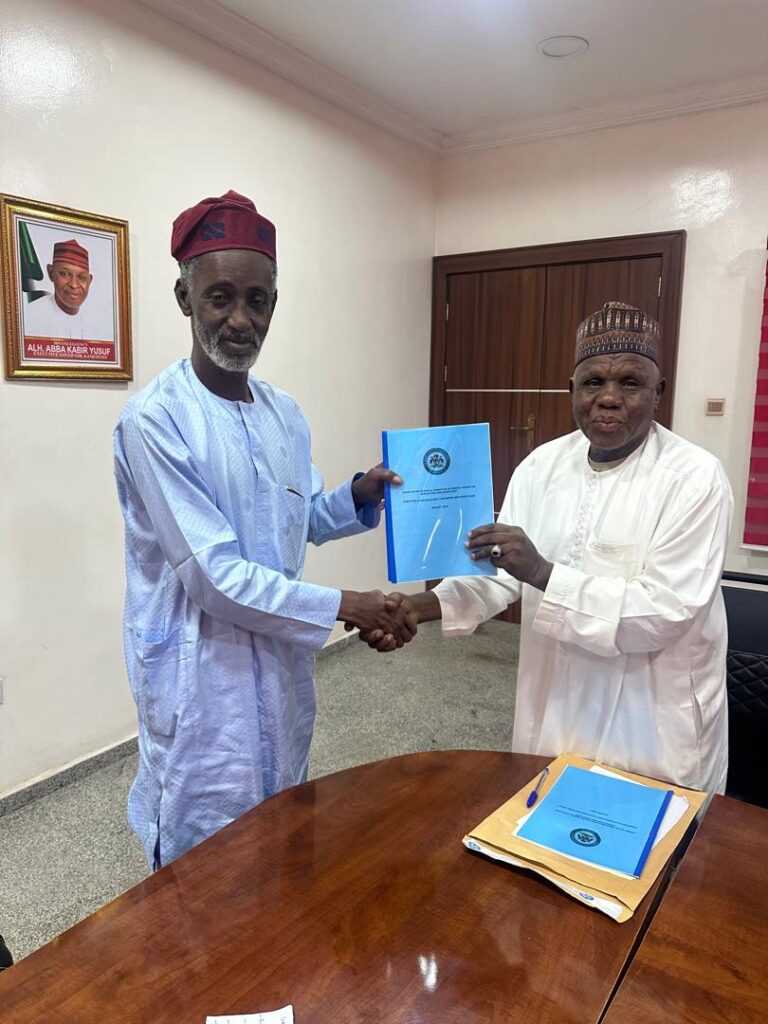
The report, compiled in a specially prepared booklet dated August 2026, was formally presented at the office of the Secretary to the State Government and received on behalf of the Executive Governor of Kano State, Alhaji Abba Kabir Yusuf.
The committee was inaugurated by the Kano State Government to undertake a technical assessment of the application of and compliance with the Federal Character principle as it affects Kano State. It was chaired by former Corps Marshal of the Federal Road Safety Corps, Hon. Dr. Danyaro Ali Yakasai.
Receiving the report, the SSG commended the chairman and members of the committee for what he described as their painstaking, thorough and selfless service to the state.
Alhaji Umar Faruk Ibrahim said the report would serve as an important resource for the government in its determination to ensure that Kano receives its rightful share of federal appointments, recruitments, opportunities and other benefits accruing to the state within the framework of the Federal Character principle.
He assured that the government would act on the findings and recommendations contained in the report, stressing that “what is due to Kano State shall be earnestly pursued and fully utilised.”
According to him, the significance of the committee’s assignment goes beyond compiling figures and records, as the report provides the state with an evidence-based foundation for engaging relevant federal institutions and pursuing legitimate opportunities for the people of Kano.
The SSG noted that effective participation in the federal structure requires not only qualified and competent citizens, but also a deliberate mechanism for monitoring available opportunities, representation and compliance with established provisions for equitable participation by the various states and sections of the country.
He expressed the government’s appreciation to the committee for undertaking the assignment with dedication and patriotism, commending the chairman and members for their invaluable contribution to the development of Kano State.
In his remarks, the committee’s chairman, Hon. Dr. Danyaro Ali Yakasai, expressed gratitude to Governor Abba Kabir Yusuf for the confidence reposed in him and other members to undertake the important assignment.
Dr. Yakasai described the appointment as both a responsibility and a privilege to serve Kano State, noting that the comprehensive report was the product of the collective efforts of committee members and stakeholders who contributed to the successful completion of the assignment.
He also appreciated government officials, stakeholders and other relevant institutions for providing the committee with the cooperation, information and support required throughout its work.
The chairman described the opportunity to serve on the committee as a source of pride to its members and assured the government that they remained available to offer their expertise and experience whenever required for future assignments.
The submission of the report marks a transition from the committee’s investigative and analytical work to the implementation stage, providing the Kano State Government with a documented basis for identifying opportunities, addressing gaps in representation and engaging relevant federal authorities where necessary.
The initiative is particularly significant as the Federal Character principle is intended to promote fairness, inclusiveness and a sense of belonging in the distribution of opportunities within Nigeria’s federal system.
For Kano State, the systematic use of accurate data, documented evidence and continuous monitoring could strengthen efforts to ensure that qualified citizens are not left behind and that the state accesses opportunities to which it is legitimately entitled.
The Kano State Government is therefore expected to carefully study the report and take appropriate steps to translate its findings and recommendations into concrete actions for the benefit of the state and its people.