
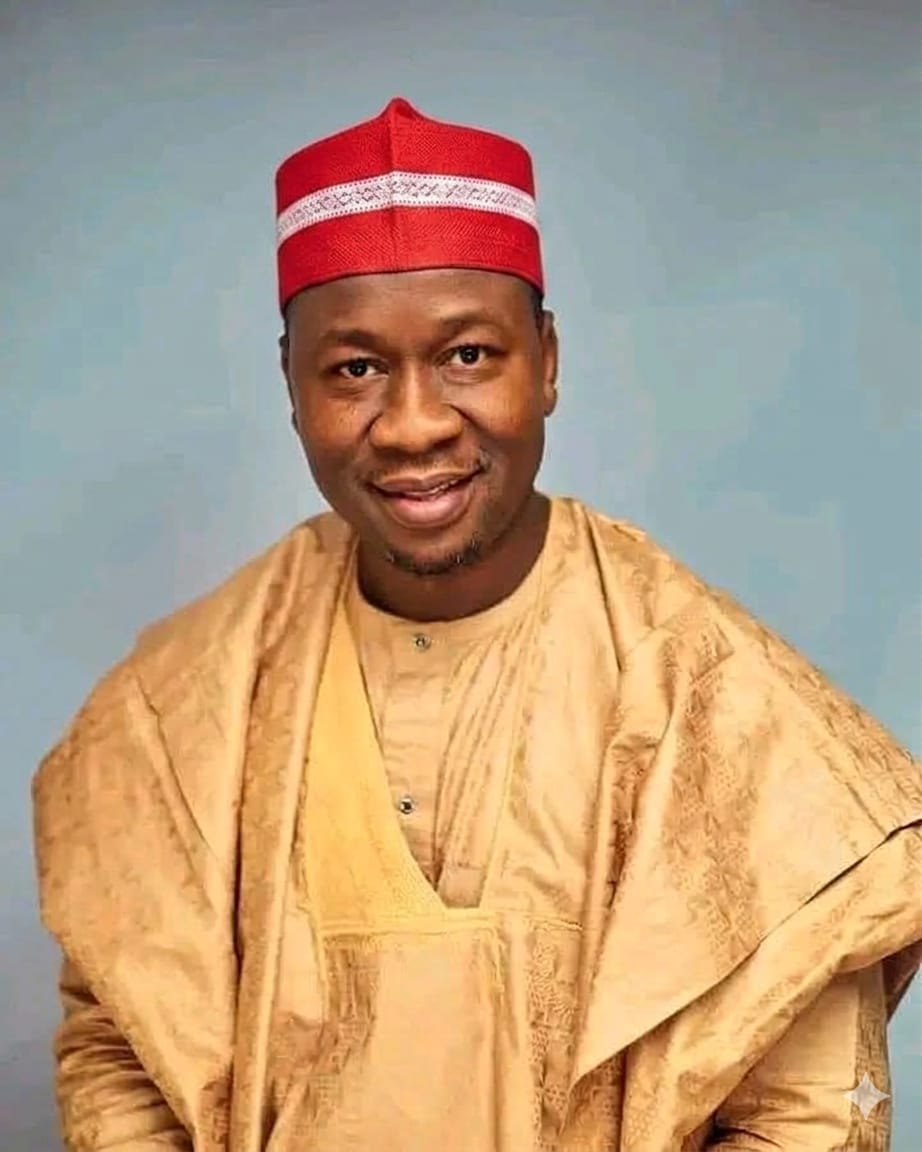
A Quiet Force Rises: Hon. Nura Lawan Musa And The Road To 2027
Early Life
Hon. Nura Lawan Musa’s story doesn’t begin in the corridors of power, it begins in the modest, disciplined setting of a family rooted in faith, values and community. Born on June 6, 1975, Into the family of Alhaji Lawan Musa and Hajiya Hafsatu, his early life was shaped by a blend of Qur’anic teachings and formal education that would later define his worldview.
Like many northern Nigerian leaders of his generation, his first classroom was the Qur’anic and Islamiyya schools, where discipline and moral grounding were instilled early. These formative years quietly built the foundation for a man who would later command both respect and loyalty.
Education
His journey through Western education at Magwan Primary School in 1982 to 1987, where his academic curiosity began to take shape. From there, he proceeded to Goron Dutse Junior Secondary School and obtained Junior Education certificate in 1990, steadily climbing the ladder of knowledge with determination.
By 1991, he had gained admission into Government Technical College, Wudil – a move that exposed him to technical and practical education with SSCE certificate in 1993, sharpening his problem-solving instincts and work ethic.
His academic pursuit didn’t stop there. At Kano State Polytechnic, School of Technology, he obtained his NCE (Technical ) in 1998, marking his formal entry into professional life as an educator.
Driven by a hunger for growth, he returned to the same institution years later, this time to the School of Management Studies, where he bagged an Advanced Diploma in Public Administration in 2006, followed by a Higher National Diploma in 2008.
Experience
Hon. Nura’s professional journey started in 2000 when he took up a teaching role at the Girls Science and Technical College (Now known as Mairo Tijjani Girls Science & Technical College). His appointment was part of the mass recruitment of 1,000 young people initiated by then Governor Rabi’u Musa Kwankwaso, a move that placed him in close touch with students and everyday community experiences. For him, teaching went beyond mere employment; it offered firsthand insight into the struggles and aspirations of the ordinary people.
He later expanded his experience into the private sector, working as a project supervisor at the now-defunct Standard Construction Company. There, he developed organizational and leadership skills that would later prove invaluable in politics.
Even outside formal roles, he became known for something more enduring, that is his commitment to community service. Whether supporting the needy or participating in grassroots initiatives, he built a reputation as a man of the people long before seeking political office.
Political Career
His political journey officially began in 2000 when he joined the All People’s Party (APP), which later evolved into the All Nigeria Peoples Party (ANPP). This marked the beginning of a career defined by resilience and grassroots connection.
In 2004, he contested and won a councillorship seat in Dala Local Government. It was here that his leadership qualities became impossible to ignore, eventually rising to the position of Majority Leader in the council.
His tenure at the local government level was widely regarded as impactful, especially due to his close collaboration with the then Dala Local Government chairman, late Mahmoud Sani Madakin Gini, a leader fondly remembered for his people-oriented governance.
Together, they drove initiatives in education, agriculture, and social welfare that extended far beyond his Dogon Nama constituency, touching lives across Dala Local Government.
By 2007, his political trajectory had taken a bigger leap. He was elected into the Kano State House of Assembly, representing Dala constituency. As Chairman of the House Committee on Information, he quickly distinguished himself as a vibrant and articulate legislator.
Within the Assembly, he built strong relationships across political lines, earning admiration from colleagues and even members of the executive arm. His ability to navigate complex political dynamics became one of his defining traits.
His legislative record spoke volumes. He sponsored bills and motions that addressed infrastructure gaps, improved education systems, strengthened healthcare delivery and supported agricultural development across the state.
Back home in Dala, his connection with constituents remained unshaken. From school renovations to medical assistance, from mosque construction to social welfare programs and provision of portable drinking water, he maintained a consistent presence in the lives of his people.
In a surprising political move in 2011, Hon. Nura stepped back from contesting elective office, choosing instead, to support another candidate, a decision that underscored his strategic thinking and loyalty to political structure over personal ambition.
The political tides shifted dramatically in subsequent years, especially with the emergence of new alliances and the eventual dominance of fresh political movements. Yet, through it all, he remained rooted in his constituency, observing, learning and recalibrating.
The PDP Journey
Hon. Nura Lawan Musa’s entry into the Peoples Democratic Party (PDP) in 2014 marked a defining shift in his political trajectory. His time in the party was characterized by relentless effort, strategic engagement and a growing reputation for resilience. Through years of active participation, he built strong relationships with key stakeholders across the state and national levels, positioning himself as a prominent force within the party’s internal structure.
Back home in Dala, his influence became unmistakable. He steadily consolidated control of the party machinery, emerging as the de facto leader in the eyes of the state hierarchy. Riding on this momentum, he contested for the House of Representatives seat in 2019, pursuing his ambition with determination despite facing legal hurdles that tested his political stamina. Although the PDP ultimately lost to the APC in the general elections, his visibility and relevance within the political space only deepened.
Undeterred, Hon. Nura returned to the ring in 2023 with renewed vigor, overcoming internal and external challenges to clinch the PDP ticket once again. However, the political landscape had shifted dramatically, as the NNPP wave led by Rabiu Musa Kwankwaso swept through Kano, securing victory in the governorship and dominating both state and federal contests. Despite the outcome, his persistence reinforced his image as a steadfast grassroots politician unwilling to back down in the face of adversity.
The Road To 2027
As the countdown to the 2027 elections gathers pace, the shifting political climate, particularly the lingering leadership crisis within the Peoples Democratic Party (PDP) has forced many key players to rethink their strategies. For Hon. Nura Lawan Musa, the cracks within the party structure at both state and national levels made it increasingly difficult to sustain a clear and viable political path.
Recognizing the need for a more stable and forward-looking platform, he began a series of consultations with political allies, stakeholders and trusted associates. These engagements ultimately shaped a decisive move that would redefine his political direction ahead of the next electoral cycle.
In a bold and calculated step, Hon. Nura parted ways with the PDP and aligned himself with the African Democratic Congress (ADC), situating his political future within the broader Kwankwasiyya movement led by Rabiu Musa Kwankwaso. The move was widely seen as a strategic convergence of shared ideals and long-term political vision.
Both men, Sen. Rabi’u Kwankwaso and Hon. Nura are known for their firm stance, resilience and deep-rooted commitment to grassroots politics.
Their political philosophies intersect on key issues, particularly the drive to uplift loyal supporters, expand opportunities beyond personal ambition and champion inclusive development.
With this alignment, Hon. Nura has effectively transferred his well-built political structure into the ADC and Kwankwasiyya fold. His track record, combined with his grassroots appeal, positions him as a strong contender for the House of Representatives seat in Dala come 2027.
Supporters and observers alike argue that his experience, loyalty and consistent engagement with constituents give him a distinct edge. Many believe he embodies the kind of leadership needed to rekindle the ideals long associated with the Kwankwasiyya movement.
There is now a growing call among stakeholders and political faithful for Hon. Nura to step into the ring once again. Equally, we the concerned Dala Local Government citizens urge Sen. Rabiu Musa Kwankwaso to leverage his firsthand understanding of Hon. Nura’s political strength and grassroots influence in Dala, as momentum quietly builds toward what could be a defining contest in 2027.
Courtesy:
Concerned Dala Local Government Citizens