
North-West Infrastructure Surge: FG Pushes Rail to 60%, Fast-Tracks Concrete Highways As Residents Applaud Impact
The Federal Government has intensified its infrastructure drive across Nigeria’s North-West, with major rail and road projects recording significant milestones amid growing public approval for improved transport systems and construction innovations.
During an inspection tour by the Presidential Media Team led by Special Adviser to the President on Media and Public Communication, Sunday Dare, officials confirmed that the Kaduna–Kano–Jigawa–Katsina–Maradi railway project has reached 60 percent completion, with delivery targeted for December 2027.
Speaking during the visit to project sites in Jigawa State, Resident Engineer with the Federal Ministry of Transportation, Engr. Ali Bukar, disclosed that work has advanced steadily across the project’s two major corridors. He noted that construction along the Kano–Dutse axis has intensified, particularly in bridge development across difficult terrains and waterways.
According to Bukar, foundation works, including piling and substructure installations for multiple bridges, are nearing completion, while superstructure installations are progressing simultaneously at several locations. He added that the Kano–Jigawa segment, spanning about 104 kilometres, and the Kano–Dutse branch line have recorded major achievements in track laying, earthworks, and structural development.
The railway project, he emphasized, is being fully funded under the Renewed Hope Infrastructure initiative of President Bola Ahmed Tinubu, underscoring the administration’s commitment to boosting regional connectivity and economic growth.
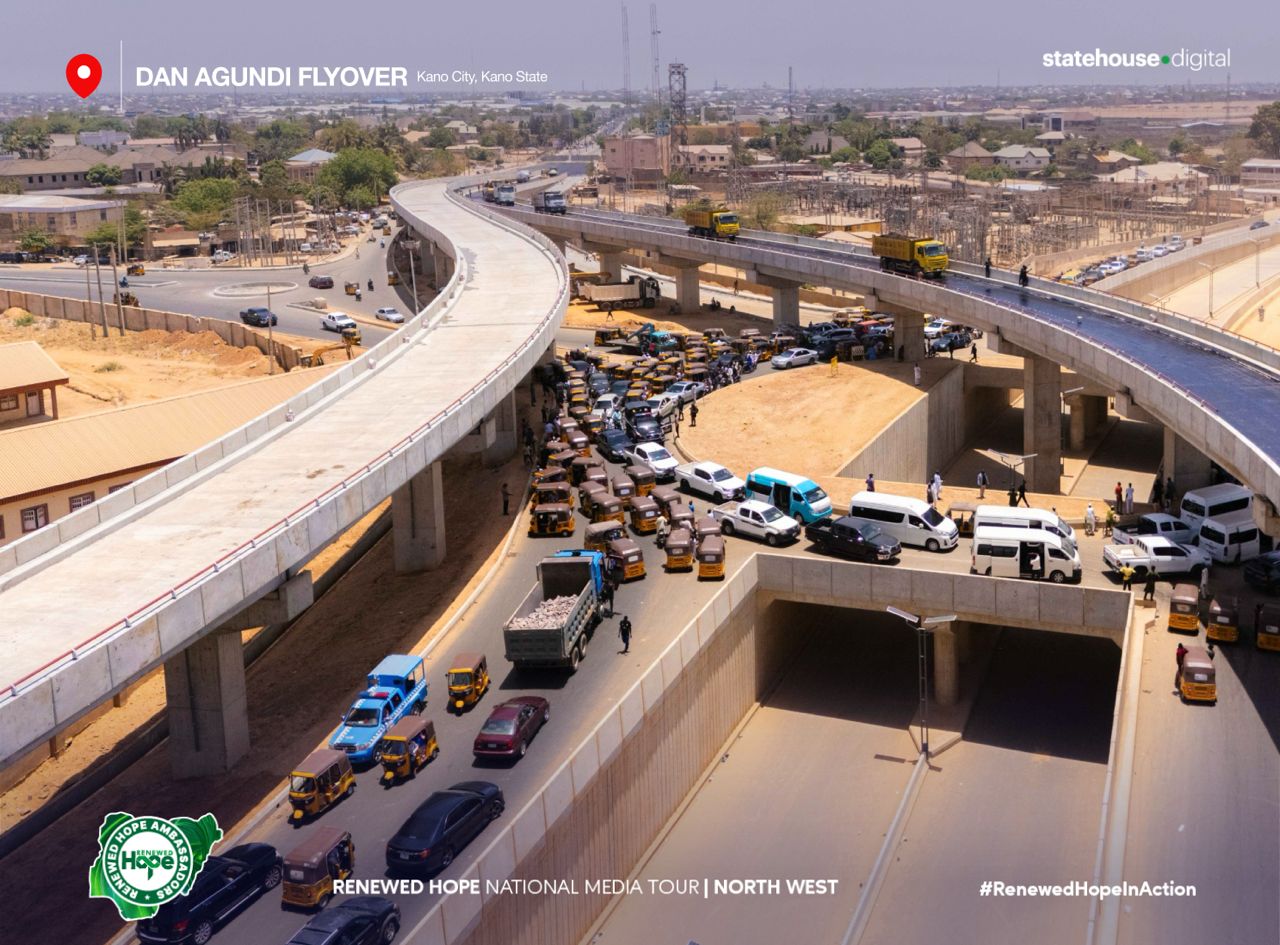
Beyond rail development, the Presidential Media Team also inspected key state-backed projects, including the Tal-Udu interchange flyover in Gwale Local Government Area of Kano State and an ongoing irrigation waterline project from Kapin Chiri Dam in Garko LGA, aimed at strengthening agricultural productivity.
In Dutse, the Jigawa State capital, attention was drawn to human capital development efforts with a visit to the Bola Ahmed Tinubu Skills Acquisition Centre, alongside an assessment of agricultural mechanisation initiatives supported by newly procured tractors.
Earlier, Presidential spokesman Bayo Onanuga noted that the ongoing projects reflect the administration’s resolve to modernise Nigeria’s transport infrastructure through durable and cost-effective engineering solutions.
On the road infrastructure front, Resident Engineer from the Federal Ministry of Works, Engr. Chukwuma Kalu, revealed that significant progress has been made on the Abuja–Kaduna–Kano highway. He disclosed that 88 kilometres of concrete pavement have been completed from Zuba in the Federal Capital Territory to Jere in Kaduna State, while the inbound Kaduna–Jere stretch covers an additional 21 kilometres.
Providing further insights, Senior Project Manager at Infoquest International, Robert Turner, said the project has generated employment for over 1,000 Nigerians drawn from host communities, ranging from engineers to machine operators and labourers.
Turner highlighted the role of collaboration in ensuring project continuity, noting that security support from the Office of the National Security Adviser, the Nigerian Army, and local communities has enabled uninterrupted work.
He added that construction is ongoing round-the-clock, with workers laying between 600 to 700 metres of concrete pavement daily. While Section One is nearing completion, Section Two is projected for delivery by November 2026.
Residents and commuters across the corridor have welcomed the new concrete road technology, describing it as a durable solution capable of withstanding heavy traffic while reducing maintenance costs and travel disruptions.
Many stakeholders see the projects as transformative, expected to ease movement between the Federal Capital Territory and Kaduna State, while strengthening economic links across northern Nigeria.
Reaffirming its role, the Presidential Media Team pledged continued transparency in reporting government activities, ensuring citizens remain informed while promoting accountability in the execution of critical national projects.