
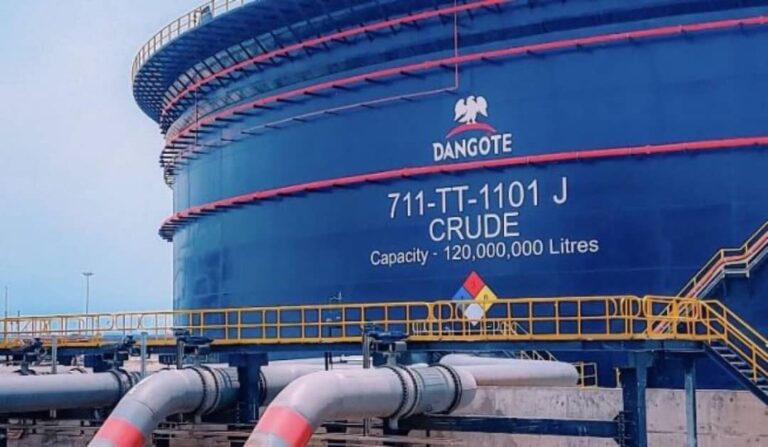
Dangote Refinery Jacks Up Petrol Price Again, Hits N1,275/ltr Hours After Hike
Barely hours after announcing an earlier adjustment, the Dangote Petroleum Refinery has stunned the market with yet another upward review of its ex-depot price of Premium Motor Spirit (PMS), raising it to N1,275 per litre in what analysts called a dramatic escalation of volatility in Nigeria’s deregulated downstream sector.
The latest increase marks a sharp N100 jump from the N1,175 per litre price recorded earlier in March, an 8.5 percent surge within weeks.
Even more striking, is the immediacy of the change, as the new price reflects a N30 increase from the N1,245 per litre announced just hours earlier on Friday night, effectively rendering its previous pricing obsolete almost instantly.
In a brief but telling communication to marketers, the refinery stated that its earlier price list “is no longer applicable,” a move that underscores the fast-shifting dynamics currently shaping Nigeria’s fuel market.
Industry watchers say the rapid-fire adjustments point to deeper structural pressures, including fluctuations in global crude oil prices, foreign exchange instability, and evolving supply-demand realities in Africa’s largest oil market.
The development also reinforces concerns about price unpredictability under Nigeria’s deregulated regime.
The ripple effects are already being felt across the value chain, with independent marketers bracing for fresh cost implications that could ultimately trickle down to consumers at the pump.
Beyond petrol, the refinery also revised its coastal pricing, raising it from N1,512,648 per metric tonne to N1,646,748 per metric tonne, an increase of N134,100, representing an 8.9 percent hike.
This signals broader upward pressure across petroleum product pricing, not limited to retail fuel alone.
The latest move by the refinery widely regarded as a game-changer in Nigeria’s energy landscape, adds another layer of complexity to the country’s transition into a fully deregulated fuel market, where prices are increasingly dictated by market forces rather than government controls.
For consumers already grappling with inflationary pressures, the timing could hardly be worse. For operators, however, it is a stark reminder that in the new energy order, price stability may remain elusive at least for now.